
While many practitioners use hair analysis simply to measure minerals and toxic metals (which is valuable in itself), the real power lies in what these minerals tell us about your metabolic type – the current operating pattern of your body.
What is Metabolic Typing and Why Should You Care?
Metabolic typing is a modern way to classify individuals based on their unique biochemical profiles. Your metabolic type tells you how your body is functioning as a system. It provides insight into how your body is processing nutrients, responding to stress, producing energy, and more. Understanding your metabolic type is the key to understanding the cause and correction for many common health problems.
Unlike generic nutrition recommendations, metabolic typing recognizes that what works for one person may be detrimental to another. This is why:
- Your friend thrives on a high-protein diet while it makes you feel sluggish
- Some people need more carbohydrates while others function better with less
- Certain supplements make you feel amazing but give others headaches
- You might need completely different nutrients than what popular health influencers recommend
The Two Primary Metabolic Types
There are two main metabolic types: Slow Oxidizers and Fast Oxidizers.
The term oxidation is similar to metabolism and refers to the rate that your body is burning carbohydrates, proteins, and fats into energy. It has a lot to do with adrenal and thyroid gland activity.
Each metabolic type has unique characteristics and symptoms, and each requires its own set of nutrients to restore balance.
Think of your metabolism as your body’s engine. Some engines run hot and fast, while others operate at a slower, steadier pace. Neither is inherently “better” – they simply have different requirements to function optimally.
However, problems occur when your body gets stuck in one of the oxidation types. Normally, your body should shift between different metabolic states as needed, but several factors can lock you into an unhealthy pattern that’s either too fast or too slow.
Symptoms of the Metabolic Types
Knowing your metabolic type can help you understand why you feel the way you do. Many physical and mental symptoms are simply due to an imbalanced oxidation rate.
It’s important to note that the following symptoms are guidelines only. Many people have symptoms of both the oxidation types. In some cases, the individual is a Mixed Oxidizer with inconsistent glandular function. In other cases, additional imbalances are present that can cause a combination of both slow and fast oxidizer symptoms.
The Slow Oxidizer: The Energy Conserver
Slow oxidizers have a tendency for the following symptoms:
- Persistent fatigue that coffee or stimulants only temporarily relieve
- Brain fog or slow, spacey thinking
- Depression, apathy, or emotional flatness
- Cold sensitivity and difficulty sweating
- Dry skin, brittle hair, and stubborn constipation
- Weight gain primarily on hips and thighs
- Low blood pressure and blood sugar
Slow oxidizers are energy conservers whose cellular metabolism operates at a reduced rate. Like a car engine idling too low, everything from your thyroid function to your neurotransmitters tends to operate below optimal levels.
Without proper support, slow oxidizers often develop conditions like hypothyroidism, chronic fatigue, depression, osteoporosis, and are more susceptible to certain cancers over time.
The Fast Oxidizer Metabolic Type
Fast oxidizers have a tendency for the following symptoms:
- Anxiety, irritability, or feeling constantly “wired”
- Racing thoughts and difficulty relaxing
- Short temper and emotional reactivity
- Feeling warm and sweating easily
- Oily skin and loose bowel movements
- Weight gain primarily in the abdominal area (cortisol belly)
- Tendency toward high blood pressure and elevated blood sugar
Fast oxidizers are energy burners whose cellular metabolism runs at an accelerated rate. Like an engine revving too high, your body burns through nutrients quickly and often operates in an unsustainable “fight-or-flight” state.
Healthy vs. Unhealthy Fast Oxidation. Healthy fast oxidizers tend to be forward-looking, positive, and energetic, active, outgoing, and extroverted. They tend to have few health concerns.
Unhealthy fast oxidizers tend toward anxiety disorders, cardiovascular issues, insomnia, and inflammatory conditions.
Four Low Electrolytes—A Separate Metabolic Type
On a hair mineral analysis, a pattern called Four Low Electrolytes or “Four Lows” is considered an additional metabolic type—separate from fast or slow oxidation.
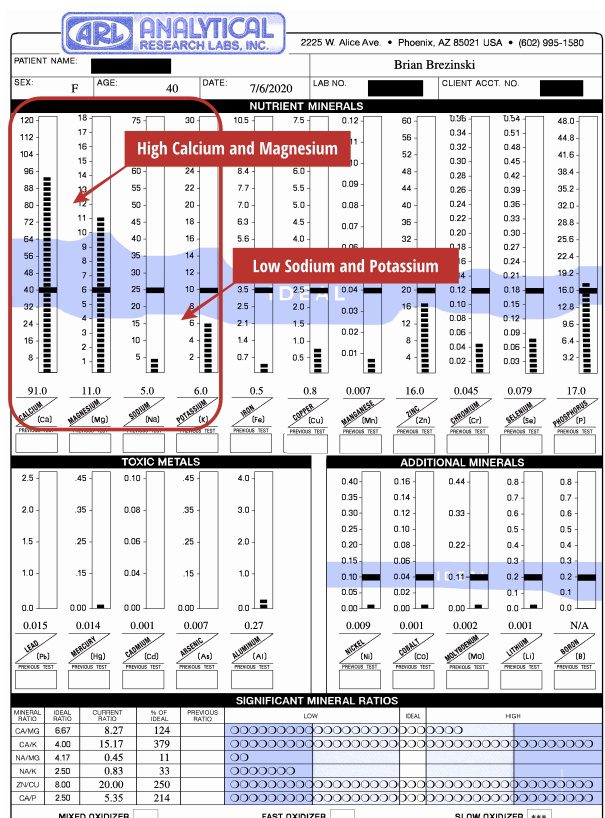
In this pattern, the four main electrolytes (calcium, magnesium, sodium, and potassium) are all below their ideal level. This is a special type of metabolic dysregulation and a deviation from the body’s normal response to go into slow or fast oxidation.
The four lows metabolic type is associated with exhaustion and a “give-up attitude.” Those with this pattern often feel “stuck” and can be cynical and negative. There is also tendency for allergies when this pattern is present.
How to Determine Your Metabolic Type
Symptoms alone can be a good guide for assessing your metabolic type. However, they are often misleading.
Some practitioners use questionnaires or other methods to determine a person’s metabolic type. But, like symptoms, these methods are less reliable. Also, some practitioners have a different idea of what the term “metabolic type” means.
Hair Tissue Mineral Analysis – A Foolproof Method for Determining One’s Metabolic Type
The best way to determine your metabolic type is to do a hair tissue mineral analysis. A properly performed and interpreted hair mineral analysis can measure your metabolic type and rate with mathematical precision. This is done by assessing the balance between calcium, magnesium, sodium, and potassium. The balance of these minerals in hair tissue is controlled largely by the adrenal and thyroid glands, which also control the body’s metabolism to a large extent.
Balancing Your Oxidation Rate Can Improve Many Symptoms At Once
Once you know your metabolic or oxidation rate, you can take steps to bring it into better balance. Thanks to the work of George Watson, PhD, and Dr. Paul Eck, many foods and nutrients have been found to influence the body’s oxidation rate.
For example, slow oxidizers need more of certain B-Complex vitamins and also vitamins C and E. They also need zinc, chromium, manganese, and other nutrients. Certain vitamins and minerals are potentially detrimental for the slow oxidizer, including iron and copper, which is present in most multi-vitamin products.
By speeding up or slowing down your oxidation rate, you can improve many symptoms and health problems at the same time. Dr. Lawrence Wilson explains this phenomenon below:
“In the body, an optimum oxidation rate may provide an optimum physical and chemical environment in which millions of enzymes function best. If we can provide this, the body simply functions better with less stress. As a result, many symptoms improve easily without the need for remedies of any kind.”
Dr. Lawrence Wilson
If you are interested in doing a hair analysis to learn your metabolic type and gain additional insight into your body chemistry, click here to learn how to order a hair analysis today.